

 Cart is empty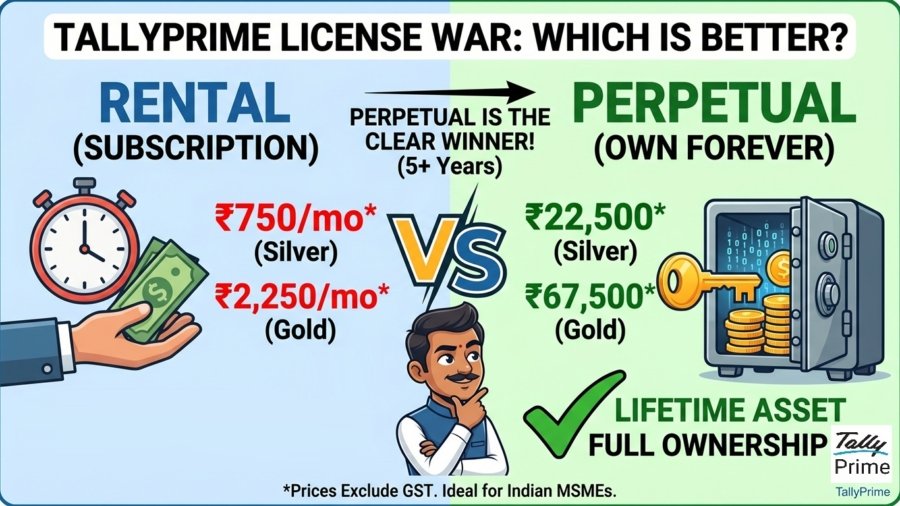
TL;DR:
While TallyPrime Rental offers an attractive entry point for startups, the Perpetual License is the superior financial strategy for any business with a 5-year horizon. It achieves a mathematical break-even at 4.56 years and is a viable choice for most businesses. Ownership ensures your data remains your asset, providing permanent access to your financial history even if you pause compliance payments.
Introduction: The Direct Answer
The choice between TallyPrime’s Perpetual License and Rental model isn’t just about price, it’s about how you manage your cash flow. In my two decades of helping Indian MSMEs navigate manufacturing, dealerships, and e-commerce, I have found that the decision hinges on whether you want to build a capital asset or manage a recurring monthly liability. With modern Indian compliance mandates like e-invoicing and real-time GST reporting, choosing the right license model determines how effectively you can balance operational costs with long-term data security.
What Exactly Is the Difference Between These Models?
The Perpetual License (Silver or Gold Editions) is a “pay once, own forever” model, representing a capital investment in a lifetime right to use the software. The Rental License is a pay-as-you-go subscription, essentially leasing the software for a specific duration.
| Feature | Perpetual License | Rental License |
| Upfront Cost (Silver) | ₹22,500 + GST | ₹750 + GST (per month) |
| Upfront Cost (Gold) | ₹67,500 + GST | ₹2,250 + GST (per month) |
| Ownership Status | Lifetime Asset | Temporary Subscription |
| Renewal Type | Not required | Required based on existing plan |
Read about TallyPrime TSS
Why Is Perpetual Better for Seasonal Businesses?
Indian trade cycles, from agricultural traders following the Rabi/Kharif harvests to brick kilns and festival retailers, often leave software idle for 6 months of the year.
The Perpetual Advantage: Under a Perpetual license, your database belongs to you. If you don’t need connected services like e-invoicing during your idle months, you can simply let your TSS lapse. You retain full access to your historical records and can continue basic accounting at zero ongoing cost.
Pro Tip: Resuming your TSS during your active months instantly restores high-value “Connected Services,” including real-time e-invoicing, automated bank reconciliation, and e-way bill generation.
The Math: When Do You Actually Break Even?
For both Silver and Gold editions, the mathematical break-even point is 4.56 years (approx. 4 years and 7 months). Beyond this threshold, the Perpetual license is significantly cheaper than continuous rental payments.
5-Year Total Cost of Ownership (TCO) Comparison
Prices exclude 18% GST. Perpetual figures assume “Optimized Biennial TSS” renewals (leveraging the 10% discount).
| Year | Perpetual Silver (Optimized) | Rental Silver (Total) | Perpetual Gold (Optimized) | Rental Gold (Total) |
| Year 1 | ₹22,500 | ₹8,100 | ₹67,500 | ₹24,300 |
| Year 2 | ₹26,550 | ₹16,200 | ₹79,650 | ₹48,600 |
| Year 3 | ₹30,600 | ₹24,300 | ₹91,800 | ₹72,900 |
| Year 4 | ₹34,650 | ₹32,400 | ₹103,950 | ₹97,200 |
| Year 5 | ₹38,700 | ₹40,500 | ₹116,100 | ₹121,500 |
Note: For seasonal businesses that only pay for compliance services 6 months a year, the Perpetual model’s break-even accelerates to approximately 2.5 to 3 years.
CapEx vs. OpEx: How Does This Impact Your Taxes?
As a Senior Accountant, I advise clients to choose based on their tax bracket and current liquidity:
- Perpetual (CapEx): Treated as a capital acquisition of an intangible asset. You can claim a 40% WDV (Written Down Value) depreciation rate in the first year.
- The 180-Day Rule: If you deploy the software on or before September 30th, you get the full 40%. If purchased after this date, the depreciation is halved to 20% for the first year.
- Rental (OpEx): These payments are 100% deductible from taxable profits in the year they are incurred, offering an immediate tax benefit for bootstrapped startups.
Expert Pro Tip (GST ITC): Don’t forget that the 18% GST paid (₹4,050 for Silver / ₹12,150 for Gold) can be claimed as a full Input Tax Credit (ITC) if you have a valid GSTIN, reducing your effective acquisition cost.
Real-World Examples: From the Field
Case in Point: The Manufacturer : A steel manufacturer in Raipur planned for a decade-long operation. By choosing a Perpetual Gold license and opting for biennial TSS renewals, they leveraged the specific savings of ₹2,600 every two years. By Year 5, they had built a permanent digital asset while paying less than a rental user.
Future-Proofing with TallyPrime & Cloud
TallyPrime is a full-scale transformation for both license types, provided your TSS or Rental is active:
- Bharat Connect: A government-backed NPCI exchange that automates invoice exchanges and payment reconciliation directly within Tally.
- PrimeBanking Payments: Securely pay vendors directly from Tally, set transaction limits, and track real-time payment status.
- TallyDrive: Automated cloud backups that run in the background, even when Tally is closed.
- SmartFind: A search “superpower” that finds any transaction across all loaded companies instantly, even with approximate spellings.
- Tally on Cloud: TallyPrime Cloud Access enables users to access the software remotely, anytime and from anywhere.
Conclusion & Actionable Checklist
The Rental model is a lease on the “key” to your data; the Perpetual model makes you the owner of the “vault.”
Use this 4-point checklist to decide:
- Financial Horizon: Is the business planned for 5+ years? (If Yes, go for Perpetual)
- Cash Flow: Do you have ₹22.5k–₹67.5k available now? (If No, go for Rental)
- Seasonality: Do you need to stop payments during off-months? (If Yes, go for Perpetual)
- Tax Strategy: Do you need a 40% depreciation shield this year? (If Yes, go for Perpetual)
Also read File Your GST Without CA in TallyPrime
FAQs
Does Tally stop working if I don’t renew TSS on a Perpetual license?
No. You retain lifetime offline access to your data. Without an active TSS, you will be unable to access “Connected Services” like e-invoicing and bank imports.
Can I use e-invoicing without active TSS?
No. Direct integration with the e-invoice portal requires an active TSS or Rental subscription.
What happens to my data if my Rental subscription expires?
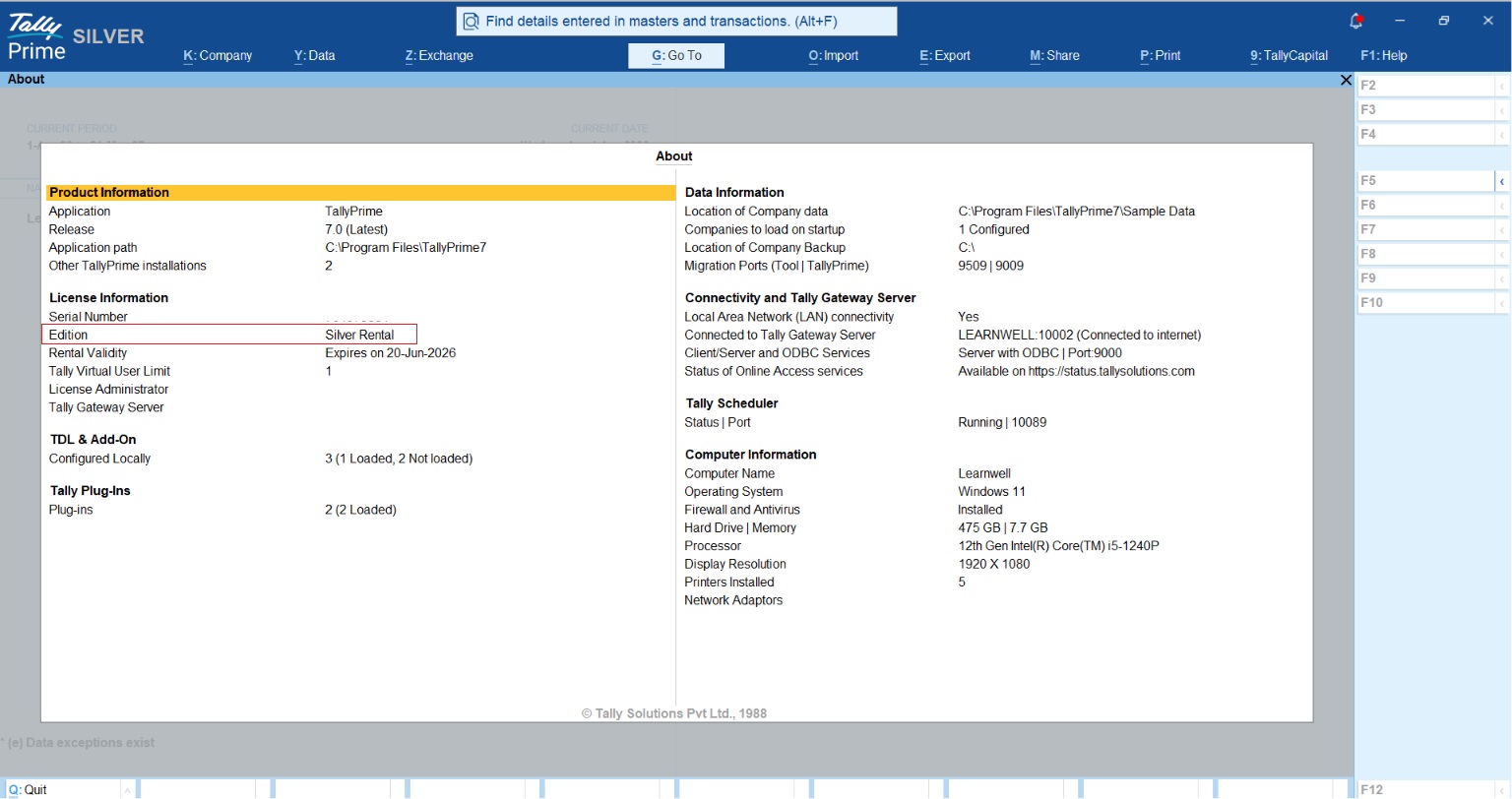
The data stays on your drive, and you must renew the subscription to access it or make more entries.
Is there a discount for multi-year renewals?
Yes. TallyPrime users get a 10% discount on 2-year TSS renewals, costing ₹8,100 for Silver (saving ₹900) and ₹24,300 for Gold (saving ₹2,600). Always check with the support team for the latest offers.
Can I switch from Rental to Perpetual later?
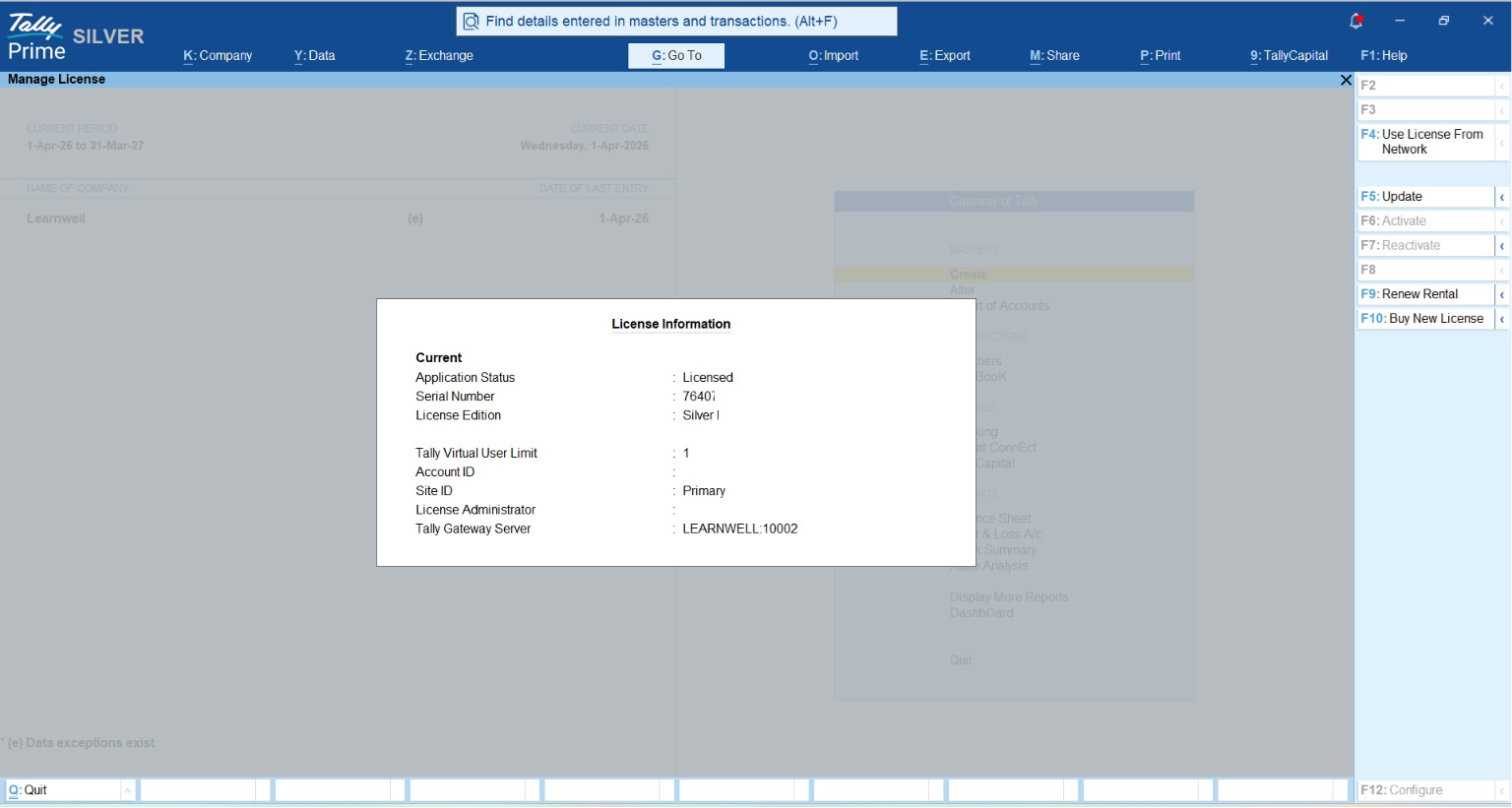
Yes, you can purchase a permanent license at any point during or after your rental period.
Does TallyPrime work on both license types?
Yes. Both plans offer a full set of features and you can access connected features like SmartFind and Bharat Connect with an active TSS subscription.
Expert Insight: “In the GST era, renting your accounting software is like renting your ledger paper, once you stop paying, the ink disappears. Ownership ensures your compliance history is always under your control.”
Get your TallyPrime
